PATRICK'S PROJECTS

teammail
ljnet
socializer
apeer
palm pilot
amusic
branchout

« home

TeamMail - Enhanced Email for Collaboration

For my capstone project in my HCI Masters program, my 5 member team, under the sponsorship of Sun Microsystems, designed and developed an email system for better supporting collaboration. They gave us an open ended challenge to find collaboration breakdowns and make a system to fix them, and we chose to focus on the integration of tasks with email.

We did an amazing job if I do say so myself, and I encourage you to look at the TeamMail site (I'm the one on the right).

LJNet - LiveJournal Social Network Browser

A common problem with social network software is that for social purposes, they have not given any functionality to end-users beyond the random wandering through linked profiles. I believe social network applications will be far more useful with effective visualizations and interaction techniques, and to that end I developed a system to explore the social network of a LiveJournal member. This social network browser (that I will soon release publicly) enables users to effectively see overall patterns in the connectivity and common interests between their friends and friends of friends - but showing is much better than explaining, so please visit my website for LJNet.

Socializer - Mobile P2P Social Platform

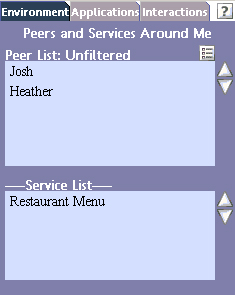
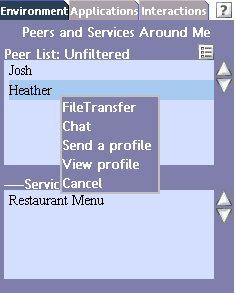
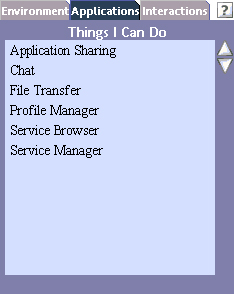
When I worked for IBM during summer 2003, they asked my 4 person team to design and build a P2P 'killer app' to push market adoption of the Java OSGi standard (dynamic services for networked devices). We created the Socializer platform by turning the existing server/client model of OSGi operation into a P2P, distributed system for PDA's and laptops. By detecting other users of Socializer in the vicinity, our platform supports pervasive mobile social interaction with both people and services via plugin applications (like chat, file transfer, etc) that can be shared in a P2P manner - you can see the various plugins being used by those around you and with a single click download them and then be able to interact in a new manner.

The interface shows users (1) who and what services are around them that they can interact with, (2) what plugin applications are currently installed, and (3) what interactions they currently have open. For example, Josh might open up his client and see Heather around (they may or may not know each other). By tapping on her name, he sees what interactions are supported by the applications they have in common (the default installation comes with the applications shown here). Much more information can be seen on the IBM alphaWorks download site.

My role involved all aspects of the project - conception, design, architecture development, UI development, and many of the sample applications. I also was the lead inventor on 2 patents that were submitted to the USPTO in December 2003. The technologies used include OSGi, J2ME, WSDD/WSAD, and P3ML.

Apeer - Weblogs meet Instant Messaging (CHI 2004)

Apeer is a social visualization for brief, topical discussions within groups. The project was an attempt to explore the social space of a new genre of communication media with the topic-centric content structure of weblogs with the always-connected, peripheral, and ephemeral nature of the instant messaging medium. It was expressly designed for use within a limited group of users to improve social awareness, common ground, and particularly group discussion. I find projects like this particularly fascinating in that they explore new ways to structure social interaction online - building such experimental environments seem extraordinarily important in evolving the next generation of computer-mediated communication.

This Apeer poster, along with this 1 page paper, were published in the 2004 CHI conference and do an excellent job describing our work and theory. We built and tested Apeer outside of classwork for our master's programs. My contributions were in the original concept generation, implementation, and user testing.

Palm Pilot UI Redesign

With a team of 4 other masters students, I performed a semester-long case study in usability methods and their applications to the Palm Pilot. Highly detailed user data was gathered from many perspectives (contextual inquiry, think-aloud, heuristic evaluation, cognitive walkthrough, GOMS, etc) and consolidated into models and abstracted breakdowns in the user experience to which we applied iterative, yet innovative, design solutions. The end result is an extensive report on not only the usability problems we found most crucial to the Palm's use and their solutions, but also a critique of the methods we used and suggestions for their improvement. The final paper is available for download.

Branch-Out - Geospatial Online Communities

A big interest of mine is online communities, and this project was a basic prototype of an augmented reality system to tie an online community of a city or university to its physical world counterpart - where all online communication is tied to a specific, physically accessible object of focus (in our case, trees in the environment support trees of conversation). The primary aspect that my teammate and I explored was what the communication between the two worlds might be like. We developed a system by which virtual world users create trees of conversation, mapped onto real tree structures, that users in the physical world can browse by using a GPS-enabled camera phone (prototyped as a webcam) with enough computer vision ability to recognize aspects of the tree (prototyped as painted colors) and overlay the appropriate text in kinetic type fashion, animating smoothly from one post's text to the next as the camera passes the boundary. In turn, virtual users can see what posts are currently being read in the space by observing the representative virtual tree branches blink.

From a very high level, only very large conversations or physical space reading activities are viewable, but as the view scales down to more local areas, smaller trees of conversation become larger but also brighter, and can be interacted with by clicking on nodes to edit and reply to them. Pictures of our prototype augmented tree will be posted soon.

AMusic - User-Empowering Music Recommendations

Following my research into Collaborative Filtering systems (like Amazon, audioscrobbler, gnod, movielens, etc), I saw that some clear problems with all such systems were their limited functionality and usability. This led me to design and build a music recommendation web app that did not require a lengthy user profiling stage to 'learn about their interests' and secondly had the functionality to refine system inputs and navigate the recommendation space. Basically I made a music recommender that (instead of just giving recommendations as ultimatums to users) used collaborative filtering to support a music recommendation search engine - so that searching becomes as quick and simple to use as a google search, and returns vastly more navigable and customizable search results than existing recommendation systems.

I do not have a web host with enough resources to leave the system live, but I can show a couple screenshots of the opening screen and the navigable search results page. The database of music connections was populated by using the google API's to find music playlists (generated by mp3 playing applications) that had been posted online, and analyzing the artist and track information across the 1,000 or so of them that I could get (over 400,000 individual songs). PS - if any college radio station is interested in hosting this system, I'd be very interested in working with you - I've already been in several conversations about such an implementation, but nothing concrete has come out of them.